
What needs to last?
Structural roles may call for durable components that can remain accessible for inspection and repair.
Sustainability is not about making every component permanent. It is about designing different layers to work, change, be maintained and eventually be replaced or recovered at appropriate timescales.
Environmental performance begins with material choices, but no material earns that description from its origin alone. Selection begins with what each function must do, how it will meet water and what happens before, during and after use.
Structural roles may call for durable components that can remain accessible for inspection and repair.
Growing and surface layers can be designed for maintenance, replacement and gradual adaptation.
Where appropriate, selected materials can be explored for recovery, reuse or a considered return to biological cycles.
A floating ecosystem combines living, renewable, serviceable and structural layers. Their environmental performance must be considered across sourcing, manufacture, transport, use, maintenance, replacement, renewal and end-of-life—not reduced to whether a material appears natural.
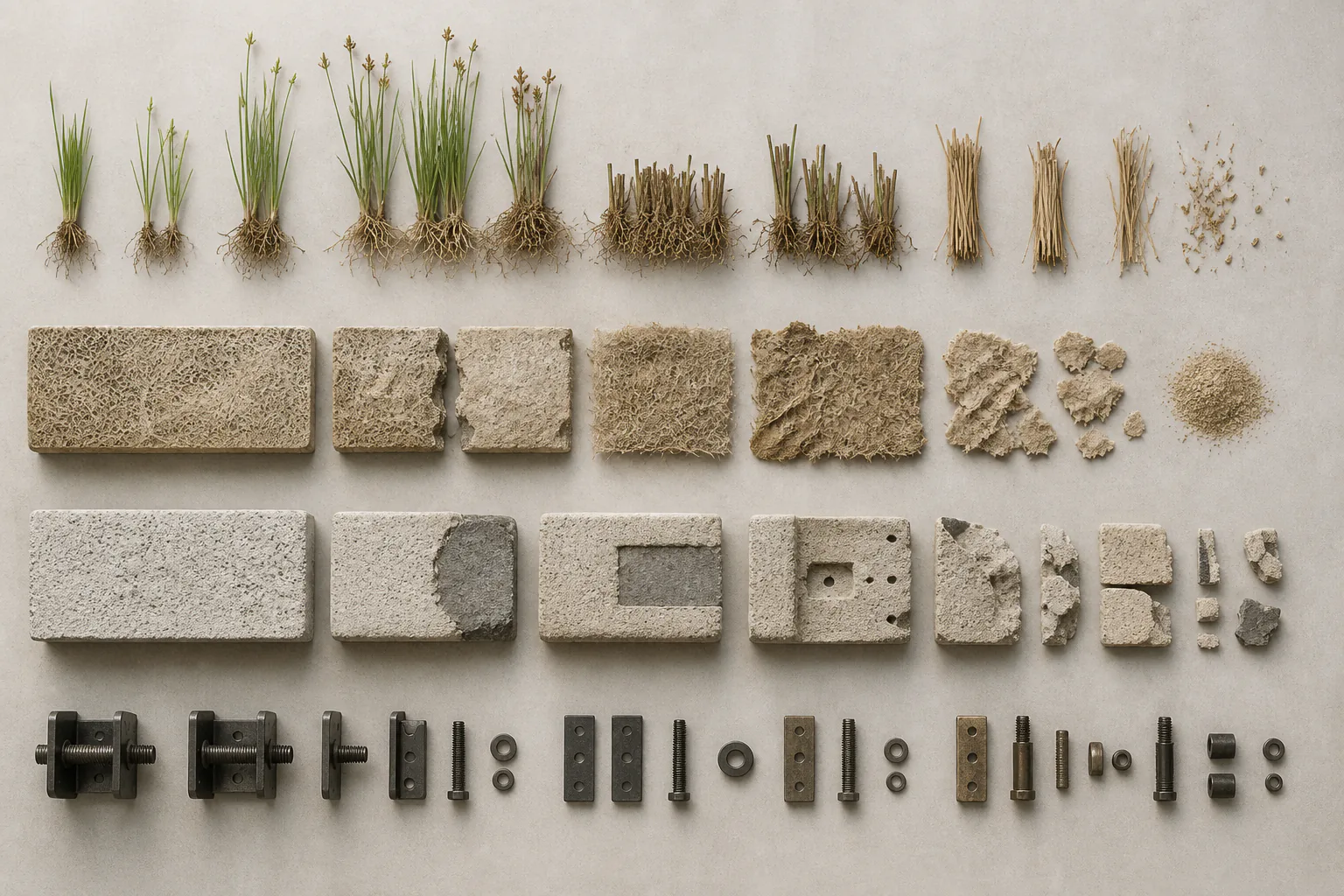
A living community that changes as it establishes and responds to the site.
A porous, accessible layer designed to support care as planting develops.
A dependable support layer whose useful life is extended through access and care.
Separable parts that make maintenance and responsible material recovery possible.
Longevity belongs to the function—not automatically to every part.
Candidate material families are considered together and remain open to change as prototyping, sourcing and site evidence develop.

Natural fibre families can be explored for planting, root contact and replaceable surface roles.

Low-density renewable or bio-based cores may offer useful buoyancy pathways, subject to water and ageing tests.

Longer-life elements can provide stability where strength, access and repeated maintenance matter.

Connections can support disassembly, repair, replacement and separation of material streams where practical.
The right combination depends on role, site, supply, maintenance and evidence.
Dry specifications are only a starting point. Candidate materials need observation across interacting forms of exposure before a role is confirmed.

Exposure is not one event. It is a changing relationship between material, water, climate and life.
Development moves through physical trials and observation. Each cycle can confirm an assumption, reveal a limit or redirect the next prototype.
Select a candidate family for a defined role.
Give the material a testable form and connection.
Expose it to relevant water and weather conditions.
Record change, interaction and maintenance needs.
Keep breaks, deformation and unexpected behaviour visible.
Revise the material, detail, role or test itself.
Follow the testing process, or begin with the conditions of a specific site and project.